Klimaatdoelen stellen
For English, scroll down.
Albert Heijn heeft wetenschappelijk onderbouwde doelen gesteld die in lijn zijn met het 1,5°C opwarmscenario. Wij verwachten dat u dit als leverancier ook doet. De doelen moeten worden opgesteld aan de hand van een onafhankelijk raamwerk, in lijn met wetenschappelijke inzichten vanuit het Intergovernmental Panel on Climate Change (IPCC). Ook moeten ze openbaar beschikbaar zijn. Voor het raamwerk en de validatie van de doelen, beveelt Albert Heijn het Science Based Target initiative (SBTi) aan. Indien u gelooft in de gelijkwaardigheid van een andere partij, draag deze dan aan voor goedkeuring via sustainablesupplier@ah.nl.
SBTi heeft voor hun validatie een maximale doorlooptijd van 24 maanden. Door deze afhankelijkheid accepteert Albert Heijn het op dit moment ook als u aan kunt tonen dat u klimaatdoelen bij hen hebt ingediend of dat u zich aan SBTi committeert en er een duidelijk plan van aanpak ligt. Hier wordt naar gevraagd in de rapportage-vragenlijst.
Over SBTi
SBTi helpt organisaties bij het opstellen van wetenschappelijk onderbouwde klimaatdoelen die in lijn zijn met de meest actuele klimaatwetenschap. Om geloofwaardigheid te waarborgen, dienen organisaties hun doelstellingen in bij SBTi voor validatie en goedkeuring. Na goedkeuring publiceert SBTi deze doelen op haar website, waardoor transparantie en verantwoording worden bevorderd en andere organisaties worden aangemoedigd om klimaatactie te ondernemen.
SBTi maakt onderscheid tussen:
-
Midden- en kleinbedrijf (MKB)
-
Groot bedrijf
Komt mijn organisatie in aanmerking voor de MKB-route van SBTi? Bekijk de SBTi criteria hier.
Om klimaatdoelen te kunnen stellen, moet uw organisatie een nulmeting doen van uw CO₂-voetafdruk. Heeft u dit al gedaan en heeft u inzicht in uw uitstoot? Ga dan naar stap 2 of 3.
Stappenplan
1. Berekenen van uw uitstoot - nulmeting
Door de nulmeting krijgt u inzicht in de uitstoot van uw organisatie. De onderstaande video’s en aanbevelingen helpen u hierbij. We raden aan om de volgende vier stappen te volgen, in lijn met het Greenhouse Gas (GHG) Protocol.

Stap 1 - Bepaal afbakening en reikwijdte

Aanbevolen vervolgstappen
- Bepaal de afbakening (grenzen) van uw organisatie aan de hand van een organogram.
- Breng de processen binnen deze afbakening in kaart, evalueer de omvang en identificeer directe en indirecte uitstoot. Categoriseer ze in scope 1, 2 en 3.
- Bekijk de vijftien scope-3-categorieën van het GHG Protocol en beoordeel of ze relevant zijn voor uw organisatie.
Tips:
- Documenteer uw afbakening en reikwijdte in een boekhoudkundig overzicht om consistente rapportage over de jaren heen te garanderen.
- Als uw organisatie deel uitmaakt van een groep, zorg dan voor interne afstemming over de consolidatieaanpak.
- Maak gebruik van de richtlijnen vanuit het GHG protocol.
Stap 2 - Verzamel gegevens voor scope 1-2-uitstoot

Aanbevolen vervolgstappen
- Betrek relevante collega’s, bijvoorbeeld op het gebied van financiën en inkoop.
- Verzamel emissiefactoren van uw elektriciteitsleverancier behorend bij uw ingekochte elektriciteit.
- Verzamel (generieke) emissiefactoren uit openbare databases, zoals DEFRA (Engels) of CO2emissiefactoren.nl (Nederlands).
Tips:
- Zorg ervoor dat u de bronnen van emissiefactoren documenteert en houd de emissiefactoren elk jaar up-to-date, omdat deze kunnen veranderen.
- Let op het juiste gebruik van meeteenheden (1 MWh = 1000 kWh; 1 tCO₂e = 1000 kg CO₂e, enz.).
Stap 3 - Verzamel gegevens voor scope 3-uitstoot

Aanbevolen vervolgstappen
- Maak gebruik van de GHG Protocol Scope 3-richtlijnen en beoordeel de 15 scope 3-categorieën op basis van een uitgavenanalyse.
- Verzamel voor alle relevante scope 3-emissiecategorieën activiteitgegevens en (secundaire) emissiefactoren.
- Vraag (primaire) emissiegegevens op bij leveranciers die samen tenminste 67% van uw totale inkoopvolume vertegenwoordigen. Geef leveranciers waarvan u veel afneemt hogere prioriteit.
Tips:
- Zorg ervoor dat u voor de uitgavenanalyse en het verzamelen van activiteitgegevens collega’s betrekt die verantwoordelijk zijn voor financiën en inkoop.
-
Overweeg het samenwerken met een adviesbureau. Om een idee te geven welke adviesbureaus u kunnen ondersteunen, verwijzen we u naar deze website.
-
Emissiefactoren voor voedingsmiddelen kunt u bijvoorbeeld vinden op:
-
RIVM (Nederland)
-
Concito klimaatdatabase (Denemarken)
-
Agribalyse (Frankrijk)
-
-
Raadpleeg de Tools & Resources pagina vanuit het GHG protocol.
-
Vul de primaire data die u heeft aan met secundaire data. Haal primaire data op bij uw leveranciers en vervang stap voor stap de secundaire data door deze primaire data.

Stap 4 - Bereken de uitstoot

Aanbevolen vervolgstappen
- Scope 1-2: Bereken uw scope 1-2 uitstoot. Overweeg om openbaar beschikbare Excel-templates te gebruiken voor het berekenen of maak uw eigen tools.
- Scope 3: Bereken uw scope 3 uitstoot. Maak hierin gebruik van zoveel mogelijk primaire data opgehaald bij uw leveranciers. Vul deze data waar nodig aan met secundaire data.
- Indien er wordt gevraagd om uw totale uitstoot, tel dan uw scope 1, 2 en 3 emissies bij elkaar op.
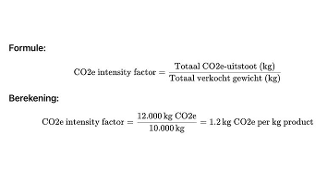
- Indien er wordt gevraagd om uw relatieve uitstoot (intensity factor), deel dan de totale emissies door de gekozen eenheid (bijvoorbeeld totaal verkocht gewicht (in kg)). Zie voorbeeld hieronder:

Tips:
- Zorg dat uw berekeningen herleidbaar zijn. Sla gegevensbronnen op in geval van externe verificatie van uw voetafdruk.
- Houd altijd rekening met het juiste gebruik van meeteenheden (grammen, kilogrammen, tonnen, etc.)
- Vergeet bij het jaarlijks bijwerken van uw voetafdruk niet om de emissiefactoren bij te werken. Vooral elektriciteit verandert jaarlijks.
- Let op: Wanneer uw emissiefactoren significant veranderen jaar op jaar, volg dan de GHG Protocol voor het herberekening van voorgaande jaren. Veranderingen in data kunnen niet als reductie worden gerekend.
2. Klimaatdoelen stellen - Midden- en kleinbedrijf
Albert Heijn verplicht u als leverancier klimaatdoelen te stellen en deze te laten valideren door SBTi (of gelijkwaardig). Voor midden- kleinbedrijven omvat dit een doelstelling voor de reductie van de uitstoot van broeikasgassen voor scope 1 en 2, en een verbintenis om scope 3-uitstoot te meten en te reduceren.
Raadpleeg de SBTi website en volg de stappen voor het stellen van klimaatdoelen. Let tijdens het proces op de uitzonderingen die van toepassing zijn op MKB-bedrijven.
3. Klimaatdoelen stellen - Grootbedrijf
Albert Heijn verplicht u als leverancier klimaatdoelen te stellen en deze te laten valideren door SBTi (of gelijkwaardig). Voor grote bedrijven omvat dit doelstellingen voor het reduceren van de uitstoot van broeikasgassen voor scope 1, 2 en 3.
Raadpleeg de SBTi website en volg de stappen voor het stellen van klimaatdoelen. Bedrijven die niet in aanmerking komen voor de MKB-route volgen het standaard SBTi-proces.
Sectorspecifieke richtlijnen voor grotere (niet-MKB) bedrijven
SBTi heeft verschillende sectorrichtlijnen opgesteld met sectorspecifieke vereisten. De meeste van onze leveranciers vallen binnen de sector “Forest Land Agriculture” (FLAG). Alle leveranciers die klimaatdoelen stellen of bijwerken (MKB uitgesloten), kunnen via deze link kijken of de FLAG richtlijnen voor hen van toepassing zijn. Niet-MKB-leveranciers die voor het eerst een Science Based Target stellen, zijn verplicht om de SBTi-FLAG richtlijn te gebruiken als ze een van de volgende producten leveren:
- Voedselproductie (landbouwproductie en/of dierlijke oorsprong);
- Voedsel- en drankverwerking;
- Detailhandel in voedingsmiddelen en basisproducten;
- Bosbouw- en papierproducten (bosbouw, hout, pulp en papier)
English
Set Climate Targets
Albert Heijn has set science-based targets that are in line with the 1.5°C global warming scenario, and we expect you, as a supplier, to do the same. Your targets must be based on an independent framework, in line with scientific insights from the Intergovernmental Panel on Climate Change (IPCC) and must be publicly available. For the framework and validation of the targets, Albert Heijn recommends the Science Based Target initiative (SBTi). In case you believe in the equality of another party, please submit this party for approval to sustainablesupplier@ah.nl.
SBTi has a maximum lead time of 24 months for validation. Because of this dependency, Albert Heijn currently accepts proof of submission of climate targets to SBTi or a commitment to SBTi along with a clear plan of action. This information will be requested in the reporting questionnaire.
About SBTi
SBTi helps organizations set science-based climate targets aligned with the latest climate science. To ensure credibility, organizations submit their targets to SBTi for validation and approval. Once approved, SBTi publishes these targets on its website, promoting transparency and accountability while encouraging other organizations to take climate action.
SBTi distinguishes between:
-
Small and medium-sized companies (SMEs)
-
Large company
Is my organization eligible for the SBTi SME-route? View the SBTi criteria here.
To be able to set climate goals, your organization must do a baseline calculation of your CO₂e-footprint. Have you already done this baseline calculation? Please proceed to step 2 or 3.
Action plan
1. Calculate emmisions - Baseline measurement
The baseline calculation gives insight into your organization's emissions. The videos and recommendations below will help you with this. We recommend following the four steps below, in line with the Greenhouse Gas (GHG) Protocol.
Step 1 – Determine scope and boundary

Recommended next steps
- Define the boundaries (demarcation) of your organization using an organization chart.
- Map out the processes within this boundary, evaluate the scope, and identify direct and indirect emissions. Categorize them into scope 1, 2, and 3.
- Look at the fifteen scope 3 categories of the GHG Protocol and assess their relevance to your organization.
Tips:
- Document your scope and boundary in an accounting overview to ensure consistent reporting across the years.
- If your organization is part of a group, make sure to coordinate internally on the consolidation approach.
- Use the guidelines from the GHG protocol.
Step 2 – Collect data for scope 1-2 emissions

Recommended next steps
- Engage relevant colleagues, for example from the finance and procurement department.
- Collect emission factors from your electricity supplier associated with your purchased electricity.
- Collect (generic) emission factors from public databases, such as DEFRA (English) or CO2emissiefactoren.nl (Dutch).
Tips:
- Ensure that you document the sources of emission factors and update them annually, as they may change over time.
- Pay attention to the correct use of units of measurement (1 MWh = 1000 kWh; 1 tCO₂e = 1000 kg CO₂e, etc.).
Step 3 - Collect data for scope 3 emissions

Recommended next steps
- Look at the GHG Protocol Scope 3 guidelines and assess the 15 scope 3 categories based on a spend analysis.
- For all relevant scope 3 emission categories, collect activity data and (secondary) emission factors.
- Request (primary) emissions data from suppliers who together represent at least 67% of your total purchase volume. Give higher priority to suppliers from whom you purchase most.
Tips:
- For spend analysis and activity data collection, make sure to engage colleagues responsible for finance and procurement.
- Consider hiring a consulting firm. To give you an idea of which consultancies can support you, please refer to this website.
- Emission factors for food can be found, for example, at:
- RIVM (The Netherlands)
- Concito climate database (Denmark)
- Agribalyse (France)
- Look at the Tools & Resources page from the GHG protocol.
- Supplement the primary data you have with secondary data. Retrieve primary data from your suppliers and replace the secondary data with this primary data step by step.
Step 4 - Calculate the emissions

Recommended next steps
- Scope 1-2: Calculate your scope 1-2 emissions. Consider using publicly available Excel templates for calculations or create your own tools.
- Scope 3: Calculate your scope 3 emissions. Make use of as much primary data as possible collected from your suppliers. Supplement this data with secondary data where necessary.
- If you are asked for your total emissions, add up your scope 1, 2 and 3 emissions.
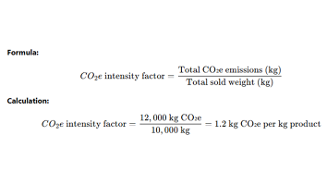
- If you are asked for your relative emissions (intensity factor), divide the total emissions by the chosen unit (e.g. total weight sold (in kg)). See example below:

Tips:
- Make sure your calculations are traceable. Save data sources in case of external verification of your footprint.
- Always consider the correct use of units of measurement (grams, kilograms, tons, etc.)
- When updating your footprint annually, do not forget to update the emission factors. Electricity in particular changes every year.
- Note: When your emission factors change significantly year on year, follow the GHG Protocol for recalculating previous years. Changes in data cannot be counted as reductions.
2. Set climate targets - Small and medium-sized company
Albert Heijn requires you as a supplier to set climate targets and to have them validated by SBTi (or equivalent). For SMEs, this includes a scope 1 and 2 greenhouse gas emission reduction target, and a commitment to measure and reduce scope 3 emissions.
Check the SBTi website and follow the steps for setting climate targets. During the process, pay attention to the exceptions that apply to SMEs.
3. Set climate targets - Large company
Albert Heijn requires you as a supplier to set climate targets and have them validated by SBTi (or equivalent). For large companies, this includes scope 1, 2, and 3 greenhouse gas emission reduction targets.
Check the SBTi website and follow the steps for setting climate targets. Companies that do not qualify for the SME route follow the standard SBTi process.
Sector-specific guidelines for larger (non-SME) companies
SBTi has drawn up several sector guidelines with sector-specific requirements. The majority of our suppliers operate within the "Forest Land Agriculture" (FLAG) sector. Suppliers who set or update climate targets (SMEs excluded) can check via this link whether the FLAG guidelines apply to them. Non-SME suppliers who set a Science Based Target for the first time are required to use the SBTi-FLAG guideline if they supply one of the following products:
- Food Production (Agricultural Production and/or Animal Source);
- Food and Beverage Processing;
- Food and Staples Retailing;
- Forest and Paper Products (Forestry, Timber, Pulp and Paper)